Is Double Meat Recommended at Subway? An Expert Explains
Subway will double the meat on any sub, wrap, salad, or protein bowl for an extra charge. It’s one of the simplest customizations on the menu, and lately, one of the most debated, now that protein has become the number people track most closely, whether they’re counting macros, training for something specific, or just trying to stay full through the afternoon.
The honest answer to whether it’s worth ordering is that it depends on the sandwich and on you. We asked Cheryl McColgan, founder of the nutrition and wellness site Heal Nourish Grow LLC.
According to McColgan, double meat can be a smart move but only under the right circumstances:
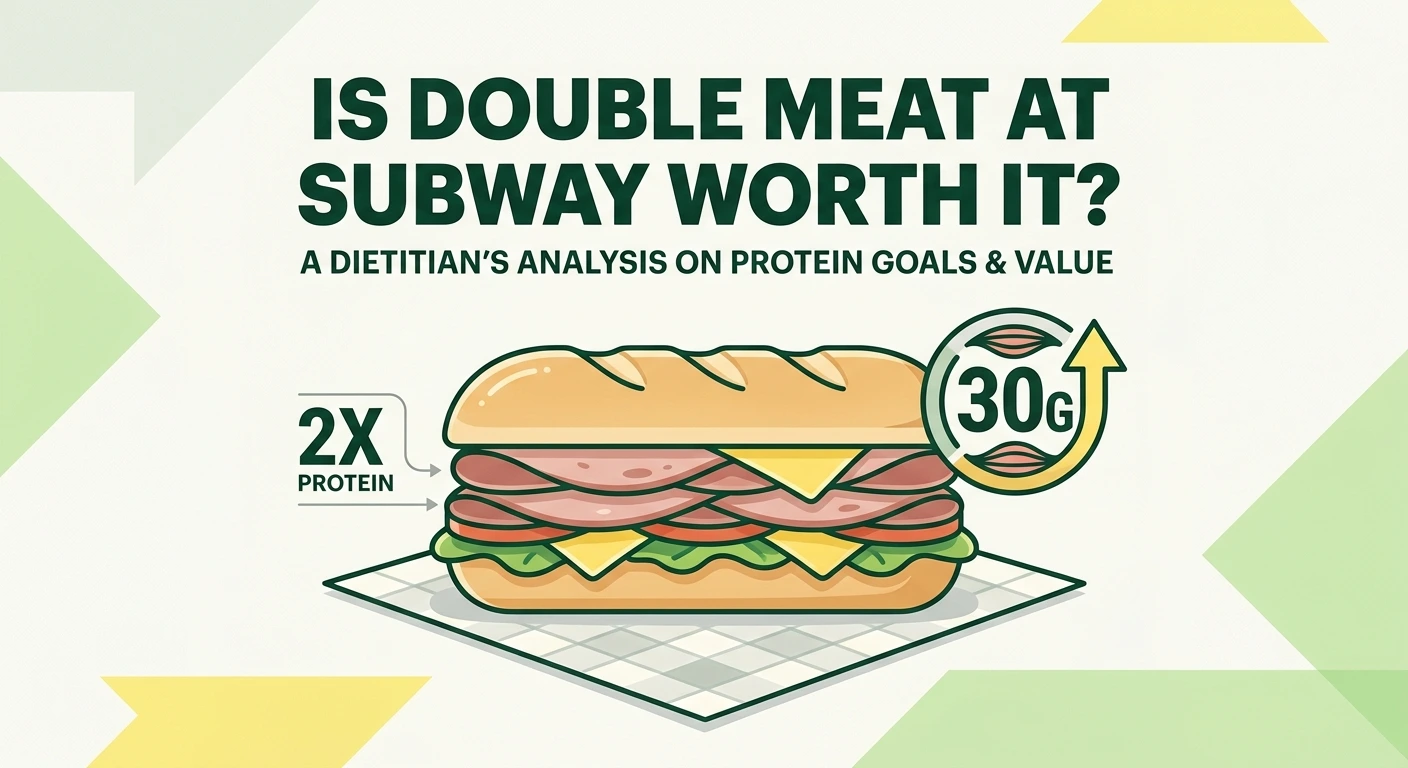
Adding double meat can be a smart strategy at Subway. After reviewing the nutrition information on their six inch subs, there are several sandwiches that fail to meet 30 grams of protein. This is an important number since it takes about 30 grams of protein to stimulate muscle protein synthesis. I would especially consider adding extra meat for the sandwiches under that threshold and for someone who is active, strength training, trying to maintain or build muscle, dieting and wanting better satiety, or simply struggling to reach their daily protein goal.”
Why 30 Grams Is the Number Nutritionists Watch
McColgan’s reference to 30 grams of protein is grounded in sports nutrition research. Multiple studies have demonstrated that consuming approximately 20–30 grams of high-quality protein per meal is sufficient to effectively stimulate muscle protein synthesis (MPS) – the process by which the body builds and repairs muscle tissue.
For active individuals, strength trainers, and those looking to preserve muscle while dieting, hitting this threshold at key meals can make a meaningful difference in body composition and recovery.
Stable isotope tracer studies tracking muscle protein synthesis for more than 12 hours have shown that larger protein doses (up to 100 g in a single meal) can produce a greater and longer-lasting muscle protein synthesis response than the traditional 20–25 g threshold. This suggests there is no strict upper limit beyond which additional protein is simply wasted, even though the incremental benefit becomes smaller as intake increases. That doesn’t undercut the practical guideline.
Around 30 g of high-quality protein per meal remains a widely recommended target in sports nutrition because it reliably stimulates muscle protein synthesis in most adults. It is a practical benchmark for evaluating a sandwich—especially after resistance exercise or for older adults, whose muscles often require a larger protein dose to achieve a similar anabolic response.
Also see: Healthiest High Protein Subway Wraps According to Dietitian
Where Standard Six-Inch Subs Actually Land
A standard six-inch sub built the classic way with bread, cheese, veggies, and a single portion of meat, covers a wide protein range, and a lot of popular options land under 30 grams on their own.
Turkey, ham, cold cut combo, tuna, spicy Italian, and meatball marinara subs typically fall in the mid-to-high 20s for protein on a six-inch, depending on bread and cheese choice, just short of the 30-gram mark. A B.L.T. or the Veggie Delite lands lower still, in the high teens, since they’re built around little or no meat.
Grilled chicken and roast beef subs, on the other hand, typically land right at or just above 30 grams on a standard build, and several of Subway’s newer signature builds and Pro series sandwiches go further still.
The chain’s Seasoned Steak & Avocado six-inch, for example, is built specifically to deliver 35 grams of protein, a sign that Subway itself is leaning into this exact conversation.
Exact figures shift with bread, cheese, sauce, and regional recipe differences, so the only way to know your specific order is to run it through a nutrition calculator rather than estimate.
The same logic applies to the meat itself, doubling the protein portion roughly doubles what that ingredient alone contributes to the sandwich, which typically adds somewhere in the range of 10 to 20-plus grams of protein depending on which meat you choose.
When Double Meat Is a Smart Strategy
- The base sandwich falls short of 30 grams – If a six-inch lands anywhere from the high teens to high 20s in protein, doubling the meat is the simplest way to close that gap in one order.
- You’re active or strength training – A higher per-meal protein dose supports the muscle repair process after a workout and hitting that in one sandwich can be more convenient than relying on additional protein snacks later in the day.
- You’re trying to maintain or build muscle – Research on body composition, in both muscle-gain and fat-loss contexts, consistently shows that higher protein intake spread across meals does more to protect and build lean mass than the same calories from carbs or fat.
- You’re dieting and want better satiety – Protein is widely considered the most filling macronutrient per calorie. A systematic review of protein-and-appetite research in adults with overweight or obesity found that higher protein intake was linked to greater fullness, which can make it easier to hold a calorie deficit without feeling deprived.
- You’re behind on protein for the day – If lunch is your best shot at a real protein total before a lighter dinner, double meat is a fast way to reach it.
Note: Doubling the Oven-Roasted Turkey or Grilled Chicken adds pure lean protein. Doubling the Spicy Italian (pepperoni and salami) or Cold Cut Combo adds considerably more amount of saturated fat and sodium.
When Double Meat Might Be Unnecessary
McColgan makes clear that double meat is not automatically the right choice for everyone:
That said, it is not automatically necessary. The best choice depends on the protein already in the sandwich, the sandwich size, what else is being eaten that day and the person’s appetite and calorie needs. If a standard serving already gives you an appropriate amount of protein for that meal, or you are pairing it with another protein-rich food, double meat may be more than you need.
- Your sandwich already clears 30 grams – A Fresh Fit build, a chicken or roast beef sub, or a protein-heavy club sandwich already does the job without an upgrade.
- You’re pairing it with another protein source that day – Greek yogurt at breakfast, a protein shake, or a dinner built around chicken or fish can close the gap without loading up at lunch too.
- Calories or sodium matter more to your goal right now – Extra meat adds calories, and depending on the protein, extra sodium and saturated fat as well.
- Cost is a real factor – Double meat comes at an added charge that varies by location, so it’s fair to weigh whether the extra protein is worth the extra price for that particular meal.
How to Decide, in Practice
Before defaulting to double meat, run through a short checklist:
- Check the protein on your standard build: Is it already near or above 30 grams?
- Think about the rest of your day: Is this your main protein source, or one of several?
- Consider your goal: Training, muscle maintenance, or a specific protein target lean toward double meat being worth it. General eating usually doesn’t need it.
- Weigh the calorie and cost tradeoff against what you’re actually trying to accomplish.
So, if your six-inch Subway order provides less than 30 g of protein and you’re trying to build muscle, stay fuller, or hit a higher daily protein target, paying for double meat is usually a worthwhile upgrade. If your sandwich already delivers 30–35 g of protein or your daily intake is already on track the extra cost and calories may not offer much additional benefit.
The fastest way through that checklist is to build the order and look at real numbers instead of guessing. The Subway nutrition calculator on this site lets you add or remove ingredients, including double meat, and see exactly how the protein, calories, and other nutrition facts change before you order.